The aiWARE OS is a layered and componentized open architecture and is the foundation of our unified AI solution. Use it to build AI-powered solutions and applications quickly, and accelerate implementation and adoption to increase operational efficiency.
Our proprietary and third-party AI models provide an ecosystem of tools with minimal integration costs.
The aiWARE OS architecture
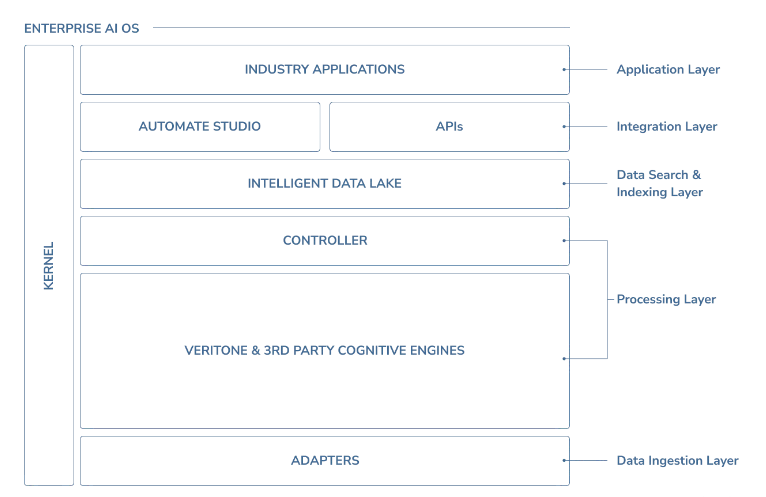
Kernel
Kernel facilitates interactions between all the components of the aiWARE Operating System. It provides a set of shared services and libraries, such as resources, hosts, security, and other services.
aiWARE Hub
Create and manage your aiWARE instances with Hub. It's the primary, self-service location for both Veritone-managed and self-managed deployments. Use Hub to:
- Create and manage organizations.
- Invite new users to create Hub accounts.
- Manage aiWARE packages, including applications and engines, that organizations can access.
Data ingestion
The first step to building powerful AI solutions is to pull data in. In aiWARE, IO adapters link the source data to the cognitive engines.
Once ingested, aiWARE securely stores the source data. To replace cloud storage and keep source data files local, deploy the aiWARE OS as an on-premises solution.
Adapters
Adapters integrate with external systems to push or pull data into or outside of aiWARE. They acquire, parse, and output that data in a format that the engines can process. Based on the interaction type, an adapter operates in a pull or push manner to retrieve data. There are several types of adapters:
- Pull adapters: These are the most common adapter implementations. A pull adapter communicates with the aiWARE system to retrieve and then pull in data from a source.
- Push adapters: These adapters let other systems send or push content to aiWARE. The data source acts as the client and notifies the adapter (server) when new data is available.
- Automate adapters: Use automated adapters as both push and pull running as an engine. You can then run them as a task like a standard adapter.
- Generator adapters: Creates content from nowhere. For example, an engine that generates lorem ipsum text or generates a silent or white-noise audio file.
Types of data
Use aiWARE to ingest and store virtually structured or unstructured data from storage or live streams. Data can come from many places, including cloud storage, local storage, web video, FTP sources, and RSS feeds, including podcasts. Data includes audio, video files, or text and images. Data is generally categorized as public or private.
Public data
aiWARE invests in aggregating and processing public data from many sources to search locally or nationally for specific terms. Some examples of public data include: Broadcast TV, radio, podcasts, web video
Private data
Data that is considered private takes many forms. Private data is only available to the organization that uploaded the media to that organization's account.
Cognitive processing
Engines and controllers are the backbones of the cognitive processing layer. Together, they bring in and manage all the incoming data.
Engines
Engines are an important part of aiWARE. They process the raw data that the adapter brings in or produces. The engines use that data to output actionable insights. Each engine process creates a unique job for each piece of media, either by programmatic auto-ingestion or by an end user. Engine processing occurs in parallel or serial fashion. There are many types of engines in aiWARE, but the most common are cognitive engines.
Developers use network-isolated versions for more opportunities to earn processing volume and revenue. This option is ideal for industries that require strict security, such as government or legal.
Define workflows for cognitive processing, including the class of engine or specific engines, to run against certain media. The real-time engine architecture delivers processing results in seconds or even sub-seconds depending on the latency of the input source. Other aiWARE engine features include:
- An expansive ecosystem: Use hundreds of production-ready cognitive engines across dozens of categories with the list growing daily. Integrate new engines into your business workflow with ease from our marketplace, or onboard your own with our developer products.
- Model performance measuring: Use built-in benchmarking tools to measure the performance of engines against each other so you can choose the perfect one.
- Standard engine output: To allow engine interoperability, the proprietary AION (AI Object Notion) format powers engine data output normalization. This frees products and customers from the binds of one engine operator.
Controller
The controller is aiWARE's cognitive processing system. It registers hosts and engine instances, manages processing, and communicates with the data lake. The controller helps:
- Process, prioritize, and allocate: Manages engine processing and ensures all tasks are assigned to engines. Recalculates and adjusts engine load and allows for task prioritization and concurrency control.
- Provide persistence, visibility, and security: Allows short-term persistence, supports transparency and auditing, and secures support for data ingestion and access.
Data search and indexing
Data lake
The data lake lets you save, index, and search data insights across engines. It provides time-correlated cognitive metadata indexing and enables multivariate, time-based search in applications. Use the data lake for its:
- Multi-variant search: Use aiWARE's cognitive search interface to search your data. Locate time-correlated AI output inside your files across multi-cognition capabilities at the same time.
- Temporal Elastic Database: Stores, manages, and searches time series data across all cognitive engine output. Locate exactly when and where extracted data insights occur in your Temporal Data Object (TDO).
- Speed, security, and scalability: Instantly locate the extracted data across billions of objects. Each object and its information are secured behind permissions and the request is automatically authenticated.
Integration
The Integration layer provides access to the layers below.
Automate
Automate Studio streamlines the creation and deployment of aiWARE cognitive solutions. Use custom flows in your project, no matter how layered. This is a low/no code solution that is reusable and scalable. This combination accelerates AI integration and enhances workflow development. Some Automate features include:
- Engines: When you deploy an Automate flow, it's created as a versioned engine. This engine can serve as a task within a DAG independently or in tandem with other aiWARE engines. These engines run on Edge processing clusters for efficient large-scale data processing at optimal scale.
- Event handling: Automate flows act as handlers for internal and external events for seamless event data integration. These flows can subscribe to native and custom aiWARE events for efficient data processing.
- Empowered applications: Automate flows inform aiWARE applications about real-time data and facilitate application triggers and third-party system integrations. Flows can also use custom NPM modules and application configurations.
APIs
The rich GraphQL-based Application Programming Interface (API) lets you securely facilitate data ingestion and access. APIs support rapid client development in applications, engines, and integrations allowing the aiWARE OS to grow, scale, and change without constant retooling. Our APIs:
- Are built for developers: GraphQL lets developers specify exact data for retrieval without repeated calls.
- Are testable: The built-in integrated API playground lets developers test in a safe environment.
- Allow full developer control: Developers control aiWARE's major systems including content, admin, processing, search, and security.
Applications
Applications connect distributed aiWARE resources for a given solution. Applications are reusable solutions that you can share across organizations and instances. They range from general-purpose to highly specialized apps that support specific use cases.
- Native OS applications: Preinstalled OS-level applications that provide critical features and functionalities.
- Customer-built applications and solutions: Industry-specific applications built on top of aiWARE that use aiWARE resources.
- Application access and security: Roles and permissions that control who has access to applications.