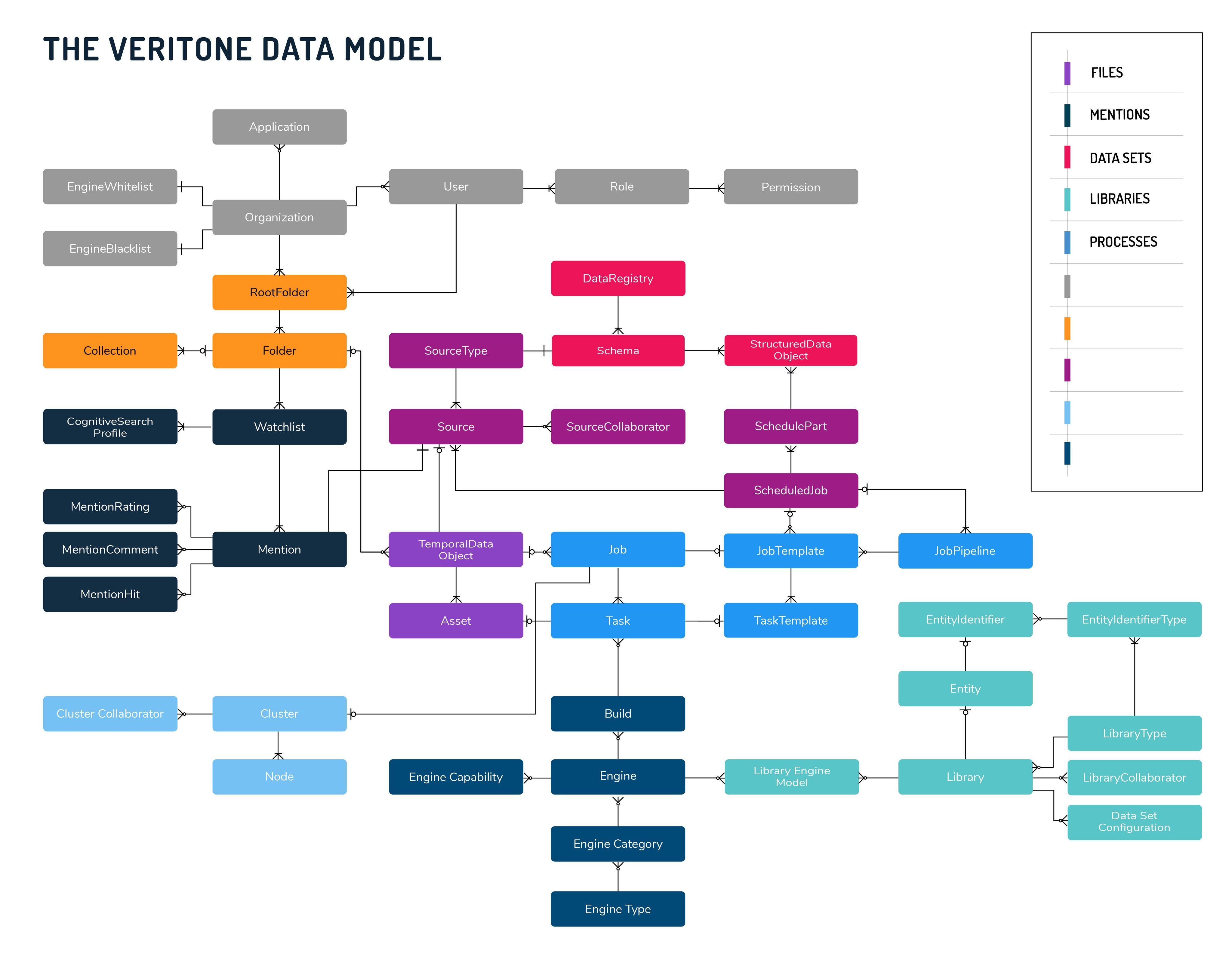
| Application | A custom Veritone client application. Third-party developers in the Veritone ecosystem can create, deploy, and market their own applications using Veritone Developer. |
| Asset | A piece of data. An asset can be consumed by an engine for analysis, or it can be produced by an engine to store results. |
| Build | A version of an engine. Engine developers upload an engine build to deploy or update their engine; a build represents the engine code. Each engine can have any number of builds representing different versions of the code, only one of which is active at any given time. |
| Collection | A group of related data. A collection can be placed in a folder, or not. Collections can be shared and publicized. |
| Engine | A self-contained, encapsulated program that is integrated into the Veritone platform and performs either AI analysis or infrastructure functions such as ingestion. Third-party developers in the Veritone ecosystem can create, deploy, and market their own engines using Veritone Developer. |
| Engine Category | A group of engines with similar features. Expected engine payload and output are common to engines within an engine category. Engine categories make it easier for users to find and select engines. |
| Engine Whitelist/Blacklist | A list of users in an organization allowed to search, view, and use a set of engines available to the organization. These lists are managed by Veritone in accordance with the organization's needs. |
| Entity | An aggregation of assets, or entity identifiers, for a defined concept, such as a person, a company or organization, an advertising campaign, a type of object, etc. |
| Entity identifier | An asset associated with an entity. Examples are headshots for face recognition, voice clips for speaker recognition, ad creative for audio fingerprinting, DLM for transcription, and aliases for transcription. |
| Entity identifier type | The type of asset associated with an entity. Examples include headshot, logo, voice clip, ad, and DLM. The library type defines what identifier types it can support. |
| Folder | A container for organizing and sharing information, including temporal data objects (media and other data), watchlists, and other folders. |
| Job | A job describes all the task necessary to perform a single high-level operation, such as run a series of engines against a piece of data or ingest data from a given source. |
| Library | A named collection of entities an organization is interested in identifying in media, e.g., American politicians. A library's type defines what type of entities it can hold. |
| Library collaborator | An external organization that a library has been shared with. Users in the collaborator organization can view the library and use it to train their own models, but cannot modify it. |
| Library engine model | A set of data generated during an trainable engine's training step. The model is (in some cases) provided to an engine when the engine is run. A model can optionally contain an asset representing the model data. |
| Library type | A description of the type of entities the library contains. Used to tailor the UI experience for specific types of entities (for example, People, Ads, etc). |
| Mention | A record that a given entity, tag, or search condition was matched (or "mentioned") in an engine result. Mentions can be shared and published. |
| Mention comment | A user comment on an individual mention. Comments are used to share, publicize, and collaborate on mentions. |
| Mention rating | A user rating on an individual mention. Ratings are used to share, publicize, and collaborate on mentions. |
| Organization | A Veritone platform subscriber. An organization can represent a company, a department within a company, or an individual developer. |
| Permission | A single functional permission on the Veritone platform, such as "create library" or "view asset". |
| Role | An abstract, business-focused way of describing a user's permissions on the Veritone platform. For example, a "Library Editor" manages libraries on behalf of the organization. A role collects a set of fine-grained permissions. |
| Root folder | An organization has an implicit top-level folder for each folder type (collection, watchlist, etc.). |
| Task | A request to run a single engine. A task is created with a payload containing input to the engine. |
| Temporal Data Object | A wrapper that contains assets and associated time series and other metadata. |
| User | A single user account within an organization, representing a human user (not a service or application). |
| Watchlist | An enhanced stored search including a set of search conditions and filters, effective start and stop date, and other information. Hits against the search captured in a watchlist generate mentions. |